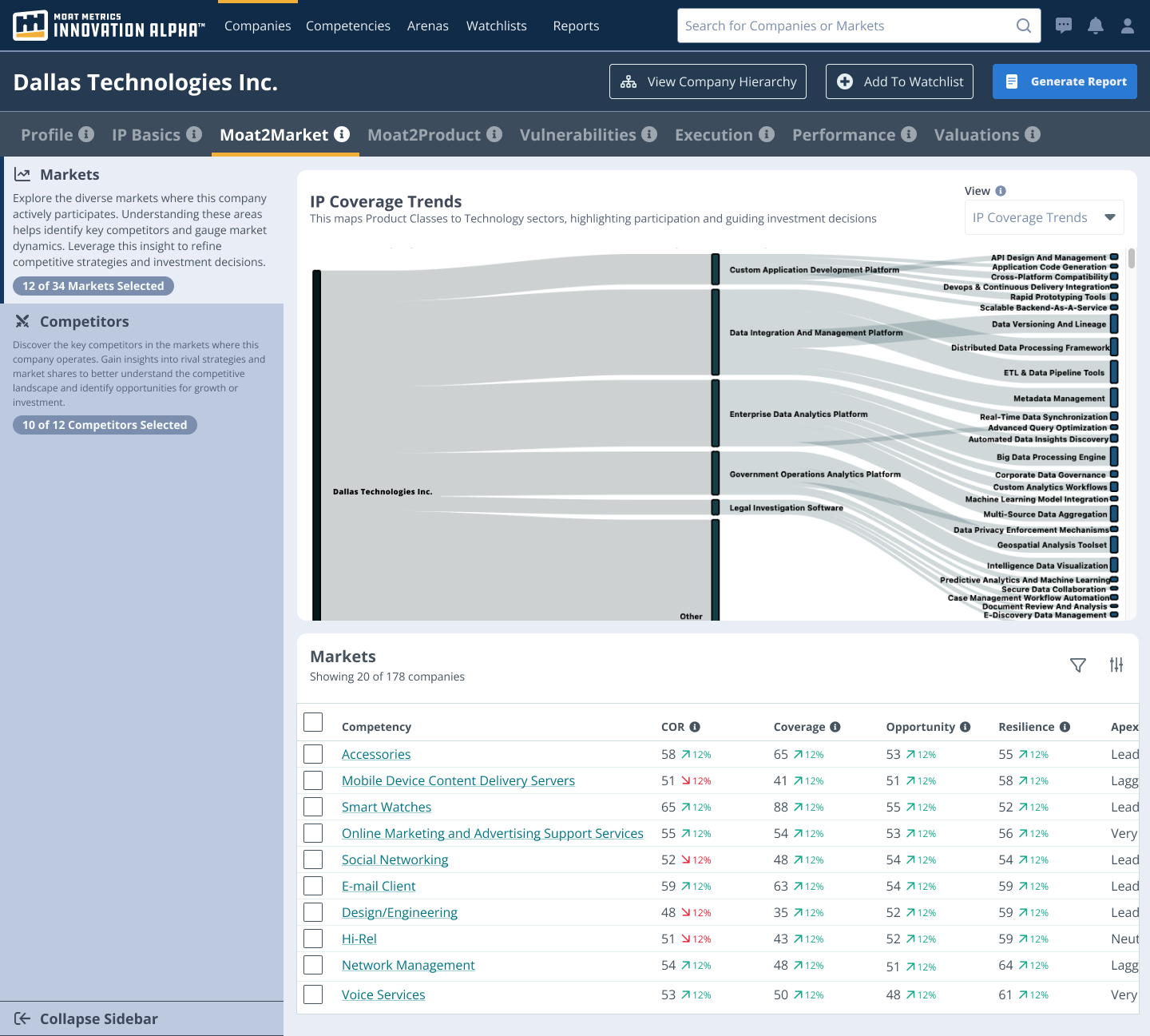
Overview
Innovation Alpha is an innovation-intelligence platform — think of it as an innovation credit check. It reads a company's intellectual property and turns it into a clear picture of how strong, defensible, and innovative that company really is. Built where finance × technology × intellectual property meet, it gives investors, along with the analysts and attorneys who work in IP, a way to see a company's true strength before the market does.
I designed it inside Aon's Intellectual Property Solutions group. In June 2024 the product spun out into its own company, Moat Metrics. I designed the new brand and carried the product across with it.
The Problem
Intellectual property tells you almost everything about a company, and almost none of it is legible. Patents, filings, litigation, and product data sit in fragmented sources that don't talk to each other, and pulling a real answer out of them took weeks of manual research.
Investors, analysts, and attorneys all hit the same wall. My anchor persona, Alex, an investor hunting for companies with strong but undervalued IP, put the shared question most plainly:
"How do you tell a company's true strength from its patents?"
My Role
As Principal UX Designer I was the only designer on the product, and owned every layer of it:
- Researching users and shaping the personas the product was built around
- Information architecture, interaction design, and UI
- Designing the data visualizations hand-in-hand with developers
- Creating the full Moat Metrics brand identity — logo, wordmark, color, type, visual language
- Rebranding the live product and restructuring its navigation through the spinout
Design Approach
- Interviewed stakeholders and experts to develop the personas. I talked with investors, IP analysts, and patent attorneys about how they actually do their work, then turned what I heard into three personas: Alex, Maya, and David. Their real objectives became the yardstick I designed and tested every decision against.
- A component-based design system. I designed against Armory, the system I built and owned, so every screen was assembled from the same library of vetted components. That made the product consistent by construction and fast to extend.
- Cross-functional collaboration. I partnered with researchers, product owners, and stakeholders to translate their thinking into functional UX, then worked closely with engineers to carry those designs into production. Design was the bridge between the thinking and the shipping.
Research & Discovery
Before designing anything I needed to understand the people Innovation Alpha was for, so I started by listening. I interviewed stakeholders across the business and subject-matter experts who lived in intellectual property every day — investing, analysis, and law.
Those conversations became three personas, each a real way someone would put the product to work:

- Alex, the Investor. Hunts for companies with strong but undervalued IP, and needs early signals of innovative potential before the market catches on.
- Maya, the IP Analyst. Benchmarks portfolios and maps competitive landscapes, turning raw patent data into strategy her leaders can act on.
- David, the Patent Attorney. Weighs validity, enforceability, and litigation risk to protect and defend a portfolio.
Building all three from real interviews kept the product honest. Every objective I later designed against traced back to something an actual investor, analyst, or attorney told me they were trying to do, rather than an assumption I'd made on their behalf.
The Solution
A shared language.
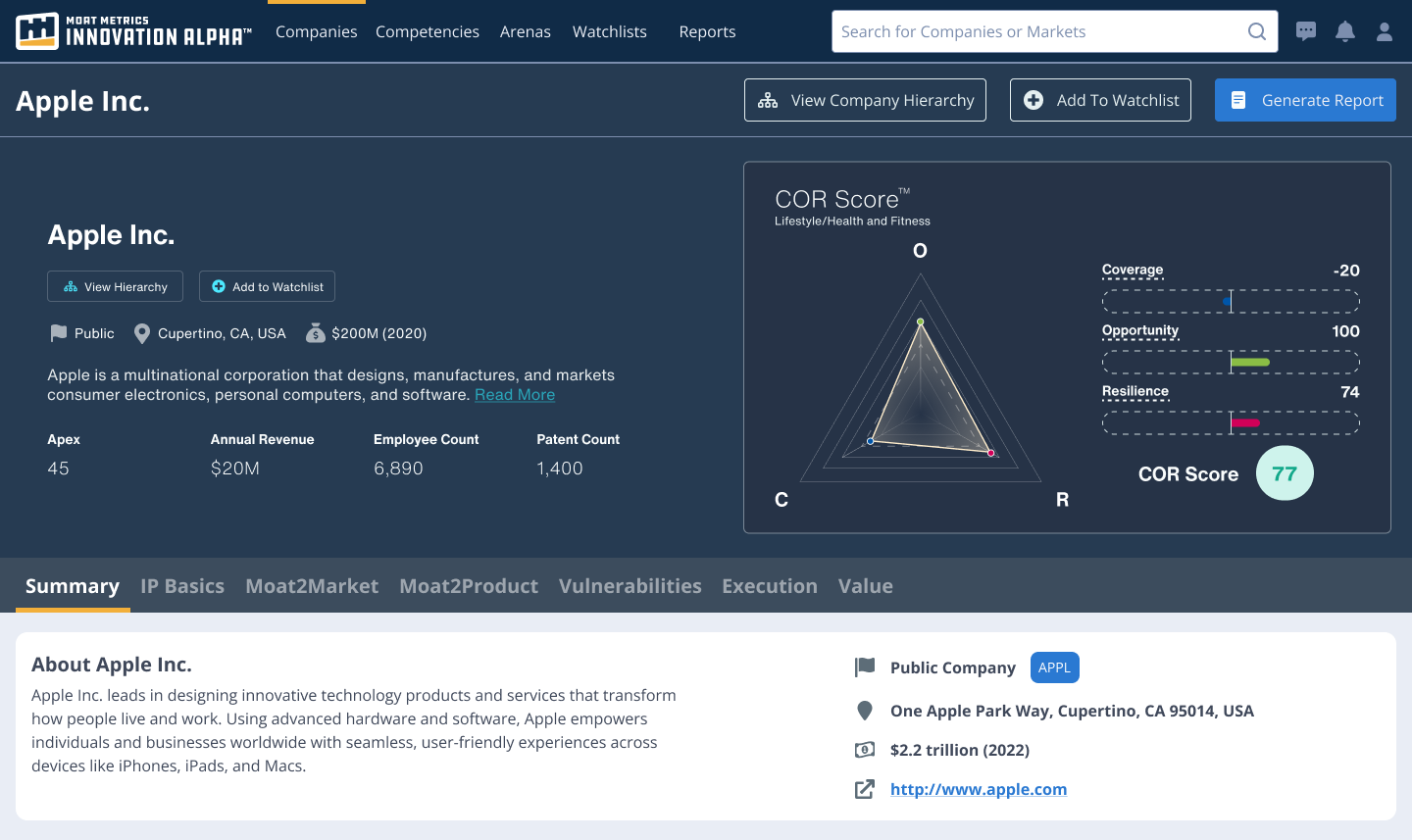
The product scores every company on four simple measures: COR, Coverage, Opportunity, and Resilience. Learn those four words once and you can read them anywhere in the app. That single decision turned a sprawling analytical model into something an investor could actually navigate. I built the framework with our researchers, whose analysis it had to stay faithful to.
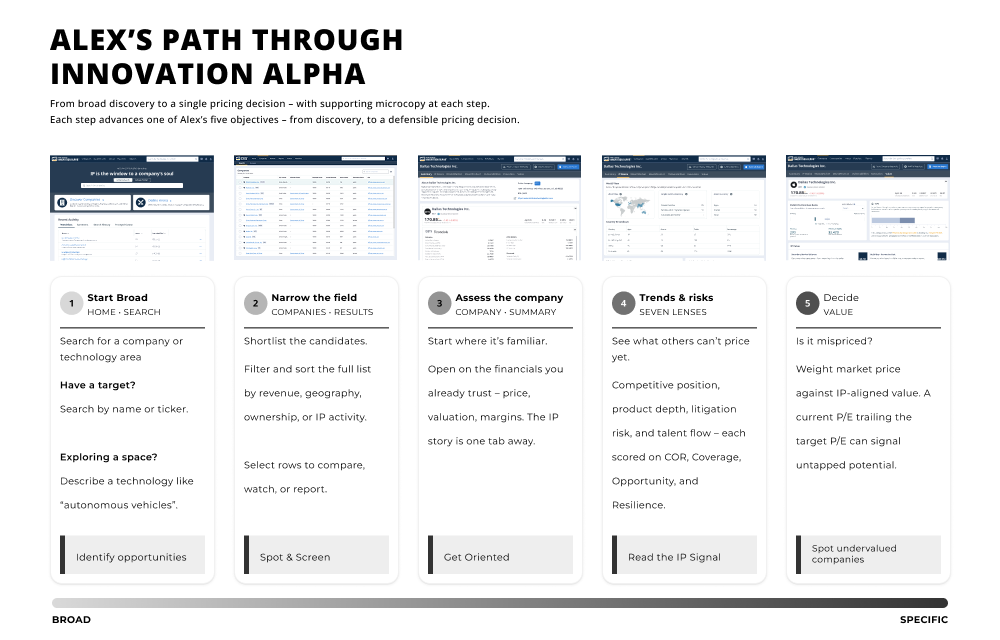
With the personas guiding the work, here's the path I designed for Alex, from broad to specific:
- Start broad: search by company name, or by an open concept like "autonomous vehicles."
- Narrow the field: filter and screen results down to a shortlist.
- Get oriented: open on the familiar financials, with the IP story one tab away.
- Read the IP signal: seven lenses covering competitive position, product depth, risk, and talent.
- Decide: weigh the market's price against the company's IP-aligned value, and see whether it's mispriced.
What Testing Told Me About My Own Vocabulary
Once there was a working product, I ran moderated usability sessions watching subject-matter experts do real work inside it. I wanted to know which signals they actually relied on to reach a judgment, rather than which ones we'd assumed they would.
What came back was harder than that. Experts trusted established industry terminology over the proprietary vocabulary we had introduced — including our own COR score.
That's an uncomfortable finding to write up when the vocabulary is the thing you designed. But it's the finding, and it changed how we talked about the framework: as a way into the analysis for people newer to IP, not a replacement for the language experts already trusted. Watching people work is only useful if you're willing to hear that the elegant part is the part getting in the way.
The Armory
A product this large needs a single source of truth, and I built and owned it. I called it Armory, the Moat Metrics design system. The name kept the brand's story running: if the product is the moat, the Armory is where every component that defends it is forged and kept in order.
Instead of packing everything into one sprawling library, I made a deliberate architectural choice: every component lived in its own Figma file. Tabs, tables, status indicators, shadows, selects, progress bars, popovers, notifications, navigation, logos, login, icons, date ranges, data visualizations, checkboxes, buttons, and cards each got a dedicated, self-contained file.
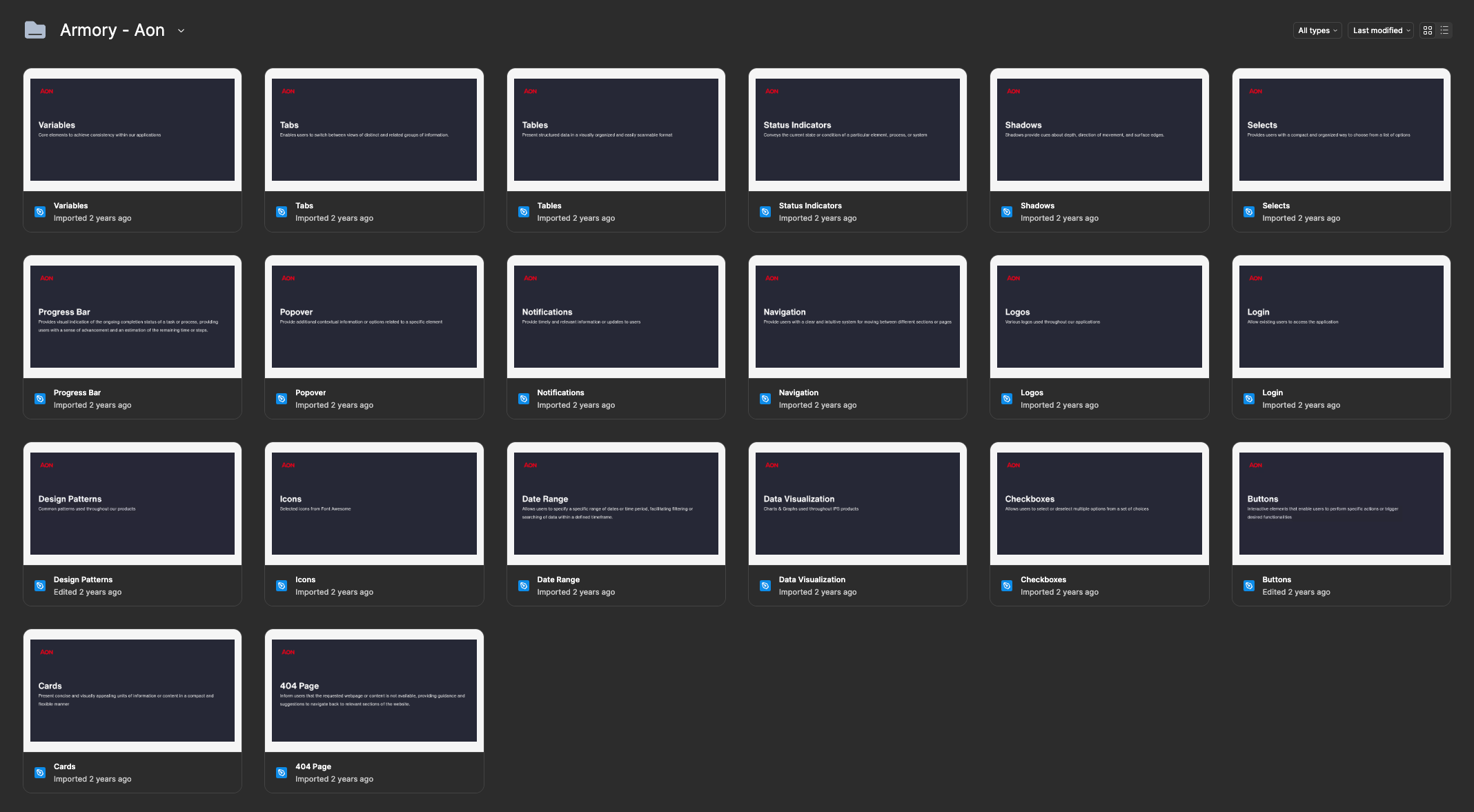
That one decision kept the system fast and manageable. It cut the bloat that bogs down a monolithic library, made any component easy to find and work on in isolation, and let me update one pattern without disturbing the rest. As the only designer maintaining it, that organization is exactly what let one person keep an entire product's design language consistent.
Its reach went past my own product. Other product teams adopted Armory as their foundation, keeping the experience cohesive across everything Moat Metrics shipped. What began as a way to keep my own files clean became the shared backbone of the company's design language.
Impact
Over roughly two and a half years, Innovation Alpha went from an enterprise platform inside Aon to the flagship product of an independent company — with a new brand, a restructured information architecture, and a complete investor experience I designed from research through release. The design system underneath it outgrew my product and became the standard other teams built on.
Reflection
Innovation Alpha was about turning data into judgment — taking something as dense as a patent portfolio and making it as readable as a credit score.
Designing both the product and the brand that carried it through a spinout reaffirmed how much of good UX is continuity: knowing what to change, and, just as importantly, what to leave exactly where people expect to find it. The users were mid-workflow the whole time. They didn't ask for a rebrand, and the best version of one is the version they barely notice.
Next project Khora